
How to Know If You Have PTSD (and How Trauma Therapy Can Help)
You might not use the word trauma to describe what happened to you.
Maybe it was something you've minimized for years. Something you told yourself wasn't that bad. Something you've never talked about because you thought other people had it worse.
But your body tells a different story. You're hypervigilant in situations that should feel safe. You flinch at things other people don't notice. You have reactions that feel way too big for the moment. You can't sleep, or you sleep but never feel rested. Something from years ago still shows up in your chest, your jaw, your stomach, like it happened yesterday.
If any of that sounds familiar, you might be experiencing PTSD. And you're not alone, even if it doesn't look the way you expected it to.
PTSD Doesn't Always Look Like What You See in Movies
Most people associate PTSD with combat veterans or survivors of catastrophic events. Those are absolutely valid forms of PTSD. But they represent a fraction of the people who actually live with it.
PTSD can develop from any experience where you felt overwhelmed, helpless, or in danger. That includes:
Physical, emotional, or sexual abuse
A serious accident or injury
Witnessing violence or death
A sudden or unexpected loss of someone close to you
A medical emergency or frightening diagnosis
Childhood neglect or growing up in an unstable home
A natural disaster
Bullying, harassment, or prolonged exposure to a hostile environment
You don't have to have feared for your life. You don't have to have visible scars. If an experience overwhelmed your nervous system's ability to process it, and the effects are still showing up in your daily life, that's enough.
To understand more about how trauma gets stored in the body and why you can't just think your way out of it, read more here. →
The Signs of PTSD
PTSD shows up differently in different people. Not everyone has flashbacks. Not everyone has nightmares. But most people with PTSD experience some combination of the following:
Reliving the Experience
Intrusive memories that pop up without warning
Flashbacks where you feel like you're back in the moment
Nightmares related to the experience
Intense emotional or physical reactions when something reminds you of what happened, a sound, a smell, a tone of voice, a location
Avoidance
Going out of your way to avoid people, places, or situations that remind you of the experience
Not wanting to talk about it or think about it
Feeling emotionally numb or disconnected
Losing interest in things you used to enjoy
Withdrawing from people who care about you
Being Constantly On Edge
Difficulty sleeping or staying asleep
Irritability or anger that feels disproportionate
Trouble concentrating
Being easily startled
Always scanning your environment for threats, even when you know you're safe
A constant feeling that something bad is about to happen
Changes in How You Think and Feel About Yourself
Persistent feelings of shame, guilt, or self-blame
Believing the world is entirely dangerous or that you can't trust anyone
Feeling detached from your own life, like you're watching it from the outside
Difficulty feeling positive emotions, even in moments that should feel good
A deep sense that something is fundamentally wrong with you
You don't need to check every box. If several of these have been present for more than a month and they're affecting your daily life, relationships, or ability to function, PTSD is worth exploring with a professional.
PTSD often shows up as chronic anxiety, panic, or depression that doesn't respond to typical coping strategies. Here are some tools for managing stress and anxiety in daily life. →
"But What Happened to Me Wasn't That Bad"
This is one of the most common things I hear from clients in Flagstaff. They describe experiences that clearly affected them, and then immediately minimize them.
"Other people have been through worse." "I should be over it by now." "It happened so long ago, it shouldn't still bother me."
Here's what I want you to know: PTSD is not a measure of how bad something was by some objective standard. It's about how your nervous system responded to it. Two people can go through the same experience and one develops PTSD while the other doesn't. That's not about strength or weakness. It's about how your brain processed the event at the time it happened.
If it's still affecting you, it matters. Your nervous system doesn't lie.
I hear this almost every week. And every time, I say the same thing: if it's still affecting you, it wasn't small.
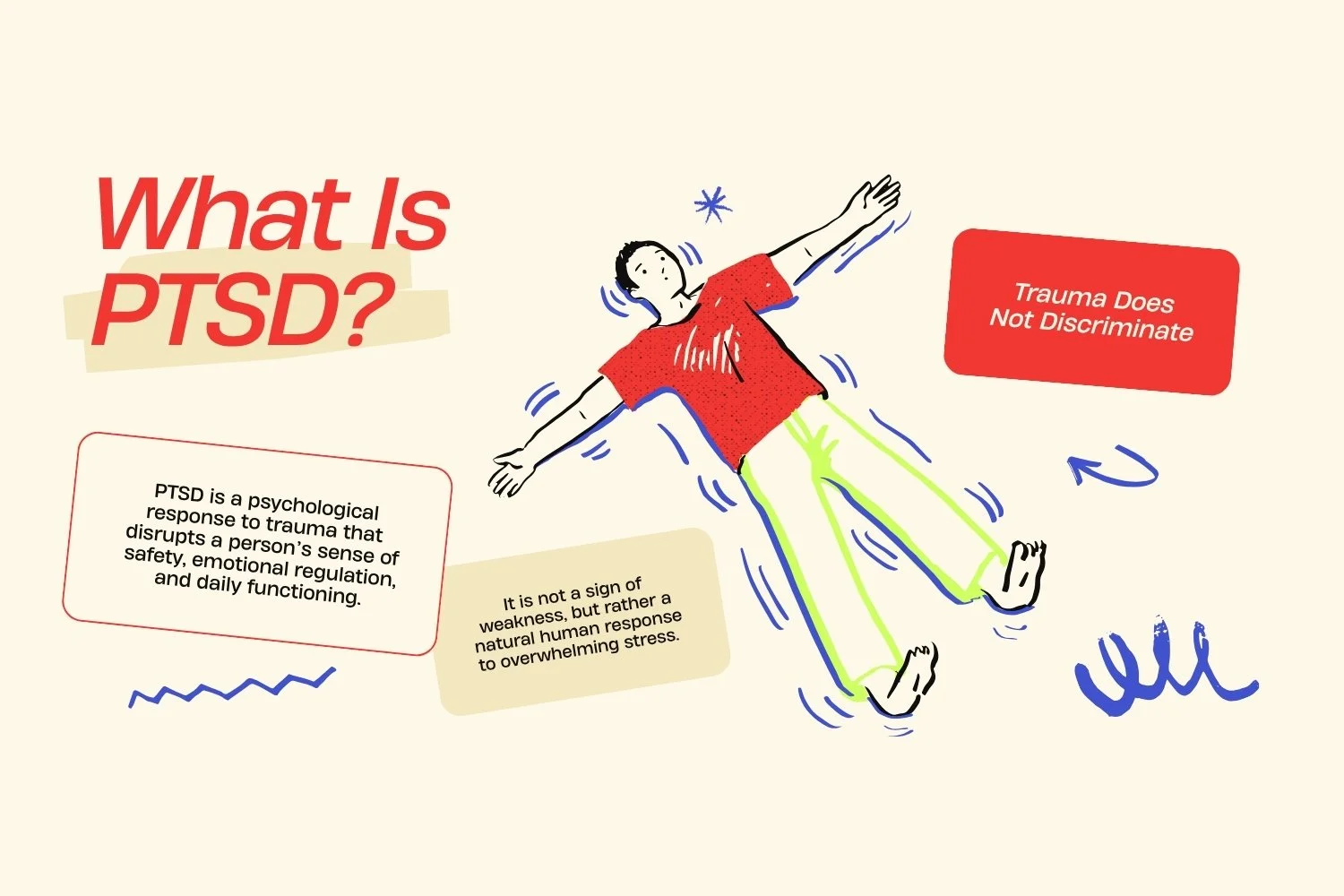
Why PTSD Doesn't Just Go Away on Its Own
When your brain processes an experience normally, the memory gets stored with a sense of time and context. You remember it happened, but it feels like it's in the past. The emotional charge fades naturally.
With PTSD, that processing gets interrupted. The memory stays stored in its raw, unprocessed form. Your nervous system treats it as if the threat is still active. That's why a sound or smell can send your heart racing even though you know, logically, that you're safe. Your thinking brain knows it's over. Your nervous system doesn't.
This is also why time alone doesn't heal PTSD. You can wait five years, ten years, twenty years. Without proper processing, the memory stays stuck in the same state it was in when it first happened. It doesn't fade on its own because it was never properly filed away in the first place.
When PTSD goes unaddressed, it doesn't just affect you. It affects your relationships too. Here's why couples lose connection and how therapy can help. →
How EMDR Treats PTSD
EMDR was specifically developed to treat PTSD, and it remains one of the most effective and well-researched treatments available.
In simple terms, EMDR helps your brain finish what it started. During an EMDR session, I guide you through a process called bilateral stimulation. This typically involves doing bilateral stimulation while you focus on a specific memory or experience. In the office I usually use vibrators in your hand. For telehealth I would have you tap on your thighs.
As processing happens, the memory shifts. The facts don't change, but the emotional and physical charge decreases. Clients often describe it as the difference between watching a movie of what happened versus being inside it. The memory is still there. It just doesn't control you anymore.
EMDR is recommended as a first-line treatment for PTSD by theWorld Health Organization, the American Psychological Association, and the U.S. Department of Veterans Affairs.
What EMDR doesn't require:
You don't have to describe the experience in detail. This is a relief for many people who find talking about trauma re-traumatizing.
You don't have to "relive" it. EMDR accesses the memory differently than talk therapy.
You don't have to spend months building up to the processing work. Many clients begin EMDR within the first few sessions, once we've established safety and identified clear targets.
In my experience as an EMDR therapist in Flagstaff, most clients will see some improvement after a few sessions and see significant healing within 3-6 months.
If you're not sure whether EMDR or traditional talk therapy would be the better fit for you, here's a breakdown of how the two approaches differ. →
Complex PTSD: When It's Not Just One Event
Some people don't have a single traumatic event they can point to. Instead, they experienced ongoing stress, neglect, instability, or emotional harm over months or years, often during childhood.
This is sometimes called Complex PTSD or C-PTSD. It can look like:
Difficulty regulating emotions
Chronic feelings of emptiness or shame
Struggles with identity and self-worth
Patterns of unhealthy relationships
Difficulty trusting others
Persistent sense that something is wrong with you at a core level
Complex PTSD responds well to EMDR, especially when combined with other approaches like Internal Family Systems (IFS) that help you understand and work with different parts of yourself. Treatment takes longer than single-incident PTSD, but meaningful change is absolutely possible.
For many people, addiction develops as a way to cope with unprocessed trauma. Here's how to recognize when a pattern has become a problem. →
You Don't Need a Diagnosis to Start
You don't need to know whether you "officially" have PTSD before reaching out to a therapist. You don't need a referral. You don't need to meet a certain threshold of suffering.
If past experiences are still affecting how you feel, how you react, how you relate to others, or how you move through your daily life, that's enough.
A brief introductory call is a simple way to share what you're experiencing and see if we're a good fit. No commitment. No pressure. Just a starting point.
I'm Ron Paul, a Licensed Clinical Social Worker and EMDR therapist with over 19 years of experience treating trauma and PTSD. I offer in-person sessions in Flagstaff and online therapy throughout Arizona. I accept BCBS, Aetna, Humana, United, UMR, and Medicare.

